Petra Lorenz · 15 September 2026
Experts Apply Plenoptic Imaging to Track Particle Movement in Fluid Dynamics Experiments
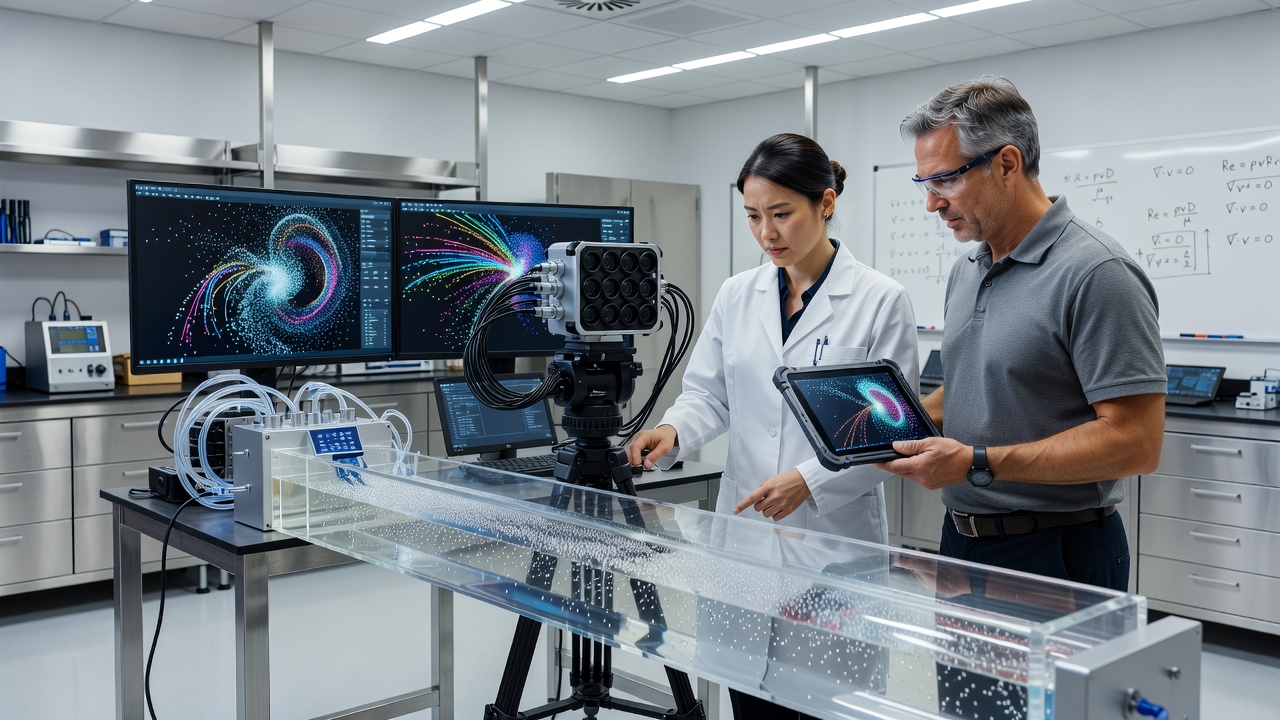
Plenoptic imaging captures both intensity and direction of light rays passing through a scene, and researchers have applied this capability to particle tracking in fluid dynamics experiments where three-dimensional velocity fields must be resolved from single viewpoints. Traditional particle image velocimetry relies on multiple synchronized cameras to reconstruct depth, yet plenoptic systems equipped with microlens arrays record directional information in one exposure, allowing computational refocusing and tomographic reconstruction after the fact.
Technical Foundations of Plenoptic Particle Tracking
Each microlens in the array sits above a small cluster of sensor pixels, sampling the four-dimensional light field rather than a two-dimensional projection, and this data structure supports ray-tracing algorithms that locate individual tracer particles in three spatial dimensions plus time. Experiments conducted in laboratory water channels and wind tunnels demonstrate that sub-pixel accuracy in lateral position combines with millimeter-scale depth resolution when particle seeding densities remain moderate, while higher densities require advanced deconvolution techniques to separate overlapping rays. Data processing pipelines now incorporate machine-learning models trained on synthetic light-field volumes, reducing reconstruction time from hours to minutes on standard GPU hardware.
Applications Across Research Facilities
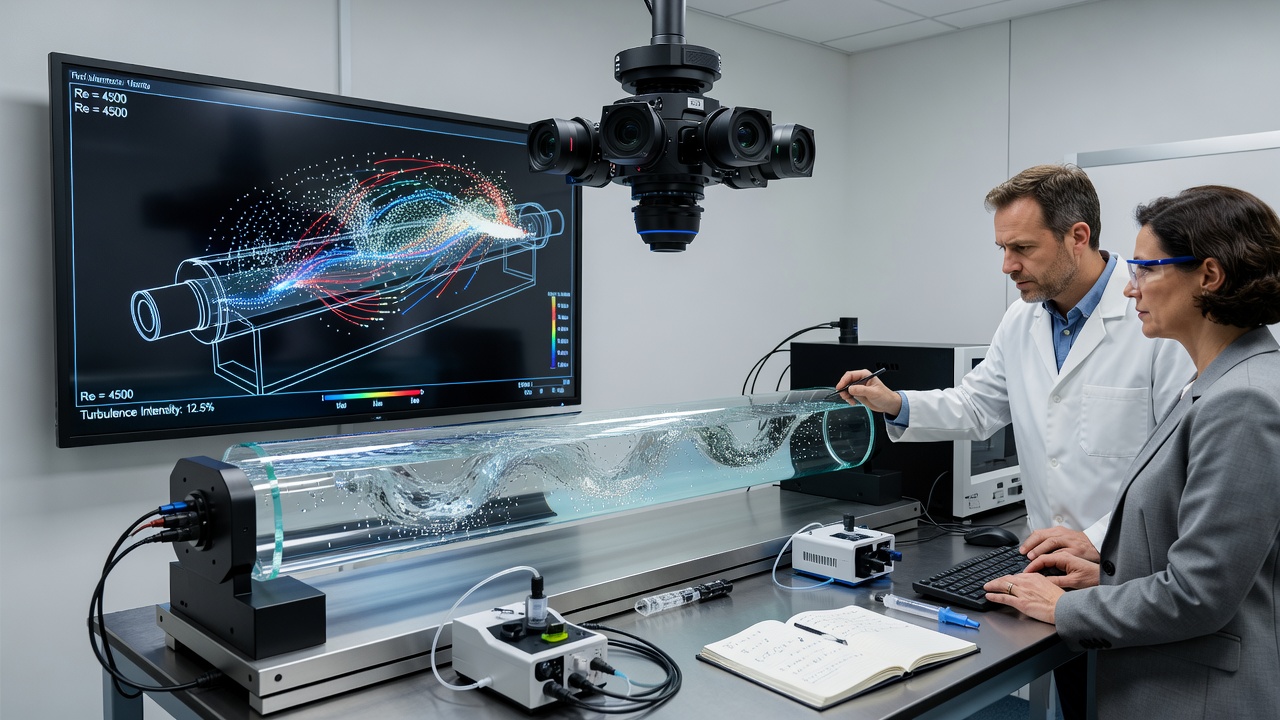
Teams at government laboratories and university wind-tunnel facilities have integrated plenoptic cameras into existing particle-image setups for studies of boundary-layer transition, turbulent mixing, and multiphase flows. In one series of tests, researchers seeded a water tunnel with 20-micron polystyrene spheres and illuminated the volume with pulsed lasers; the plenoptic sensor recorded volumes up to 200 millimeters deep, yielding instantaneous three-component velocity vectors across an entire measurement domain rather than a single plane. Similar configurations appear in aerospace testing where compressibility effects alter particle trajectories, and observers note that single-camera operation simplifies alignment while maintaining calibration stability across temperature changes in the tunnel.
Recent Developments and 2026 Milestones
Hardware improvements introduced in 2024 and 2025 include higher-resolution microlens arrays and faster readout electronics that support kilohertz volume rates, and these advances have expanded the technique to high-speed cavitation and combustion studies. Plans for September 2026 include a coordinated measurement campaign at multiple international facilities where standardized particle-laden jets will be imaged simultaneously with plenoptic and conventional tomographic systems, allowing direct comparison of uncertainty budgets under identical flow conditions. Preliminary scheduling documents indicate participation from North American, European, and Asia-Pacific laboratories, with shared calibration targets and open-source processing code released ahead of the campaign.
Integration with Complementary Techniques
Plenoptic data volumes lend themselves to fusion with other diagnostics such as laser-induced fluorescence or acoustic measurements, because the light-field representation already encodes spatial coordinates that simplify registration. Engineers have combined plenoptic particle tracking with background-oriented schlieren imaging in a single optical path, extracting both density gradients and velocity vectors from the same sensor exposure. Such multimodal approaches reduce experimental complexity while increasing the information extracted per run, and figures from recent joint publications show correlation coefficients above 0.95 between independent velocity estimates.
Challenges and Ongoing Refinements
Depth resolution remains limited by the angular sampling provided by the microlens array, and scattering from dense particle fields can introduce artifacts that require iterative reconstruction methods. Calibration procedures now account for refraction at fluid interfaces through ray-tracing models rather than simple pinhole assumptions, and validation against known translation stages confirms residual errors below one pixel in all three coordinates. Software frameworks released by academic consortia incorporate uncertainty propagation from raw light-field data through final velocity fields, giving experimenters quantitative confidence intervals for each vector.
Conclusion
Plenoptic imaging continues to extend the measurement envelope for fluid dynamics experiments by delivering volumetric particle positions from compact optical arrangements, and ongoing hardware and algorithmic work supports broader adoption across research domains. Coordinated efforts scheduled for September 2026 will provide standardized benchmarks that clarify performance limits relative to established multi-camera methods, while open data initiatives facilitate comparison across facilities worldwide. The technique therefore supplies a practical route to three-dimensional flow diagnostics without proportional increases in hardware complexity.