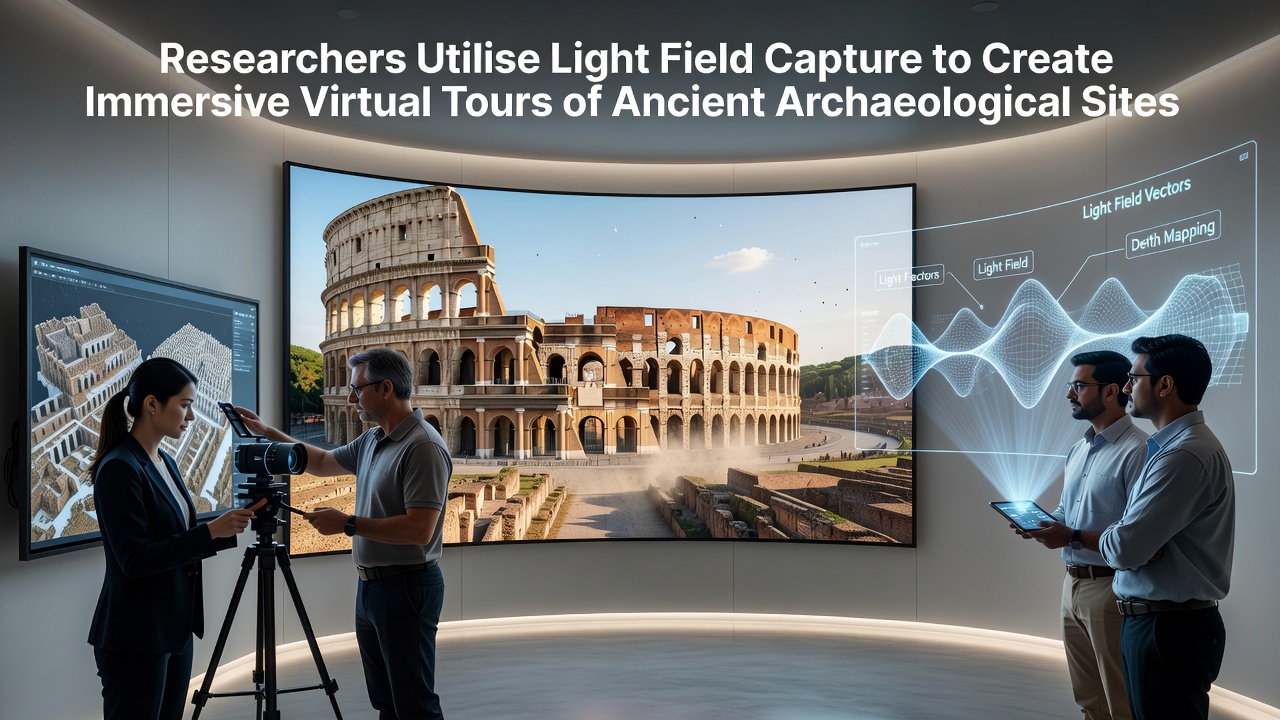
Researchers Utilize Light Field Capture to Create Immersive Virtual Tours of Ancient Archaeological Sites

Articles

Researchers Utilize Light Field Capture to Create Immersive Virtual Tours of Ancient Archaeological Sites

Archaeological teams have integrated light field capture systems into documentation workflows at sites across multiple continents, and this approach records both spatial and …

Petra Lorenz 13 October 2026

About the Coverage

Articles examine concrete advances such as improved microlens arrays, depth-estimation algorithms and compression techniques for large light-field datasets. Each piece summarises methods, results and remaining technical constraints reported by research teams. Readers encounter primary sources and measured assessments rather than forecasts or product endorsements. The editorial focus stays on verifiable laboratory outcomes and conference proceedings.

Core Topics

Three recurring strands structure the reporting. Sensor hardware tracks pixel-density gains and calibration routines. Software developments cover reconstruction pipelines and noise-reduction approaches. Application studies describe controlled experiments in microscopy, materials inspection and environmental monitoring. All items link to original papers or public datasets where available.

  • Sensor hardware updates
  • Reconstruction algorithms
  • Field experiment reports

Editorial Standards

Every story cites methods, sample sizes and error margins drawn from source material. Speculation is avoided; only documented findings appear. The archive remains accessible for cross-referencing earlier results against newer replications. Corrections are issued promptly when authors or institutions supply updated data.

A longer index of Lichtfeld Light Field Research references is kept on the Professional Resource Center page.

Articles

Stories and Guides